
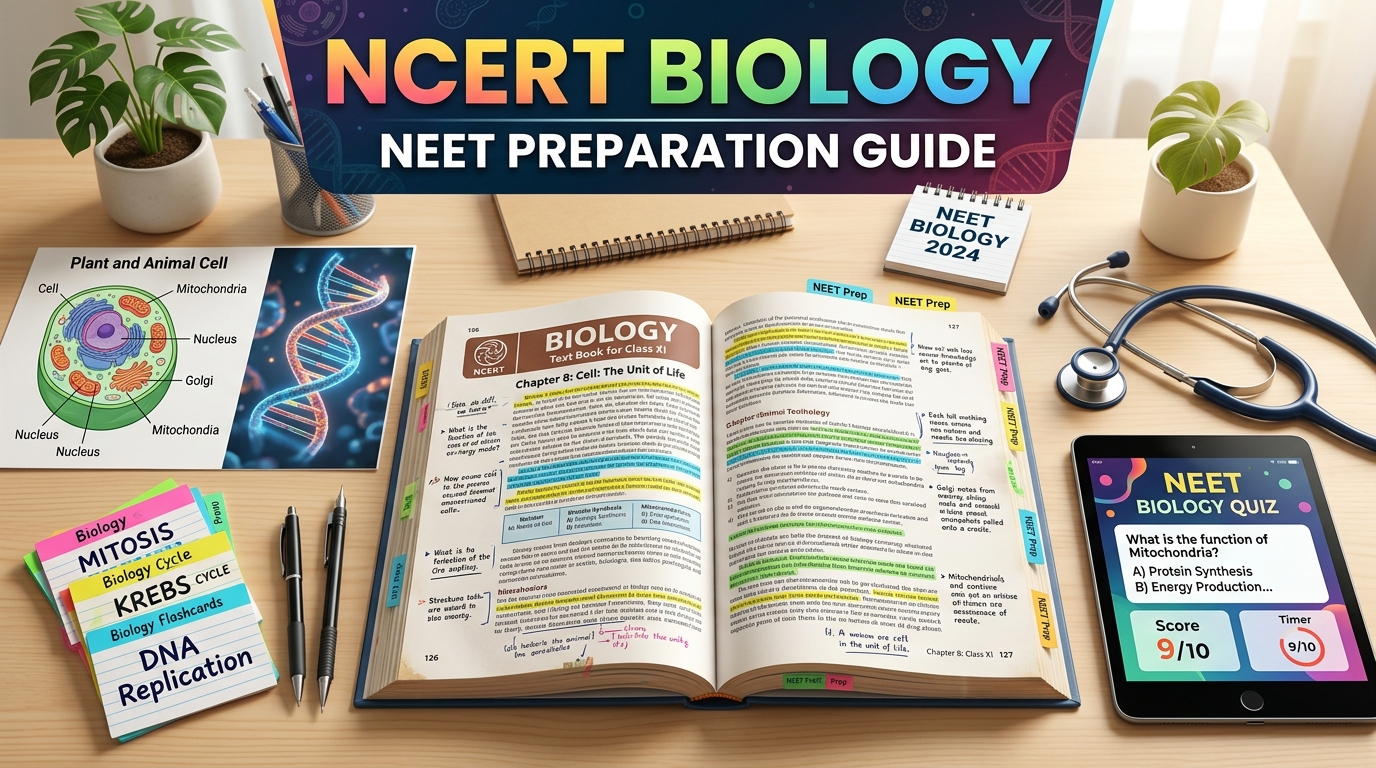
How to Master NCERT Biology for NEET: Chapter-Wise Strategy, High-Weightage Topics & Note-Taking Hacks
A comprehensive guide on reading NCERT line-by-line, mastering diagrams, solving PYQs, and using MockX flashcards to target 360/360 in NEET Biology.
Biology holds the key to cracking NEET. Accounting for 50% of the total marks (360 out of 720), a strong performance in Biology (Botany and Zoology) is non-negotiable if you aim for a top Government Medical College or AIIMS.
The most critical secret toppers know is simple: over 95% of questions in NEET Biology come directly from NCERT textbooks. However, reading NCERT like a storybook is not enough. To score a perfect 360/360, you need a line-by-line decoding strategy, active recall techniques, and targeted practice.
In this guide, we break down how to master NCERT Biology for NEET, detailing chapter weightage, active note-taking hacks, diagram strategies, and how MockX helps you convert raw textbook reading into exam-day accuracy.
📌 Why NCERT is the Ultimate Bible for NEET Biology
The National Testing Agency (NTA) designs NEET questions around the exact wording, diagrams, tables, and summary sections of Class 11 and Class 12 NCERT Biology.
| Question Category | Weightage | Target Skill & Focus Area |
|---|---|---|
| Direct NCERT Text Lines | ~80% | Direct memory & factual recall |
| NCERT Diagram & Table Based | ~10% | Visual comprehension & data interpretation |
| NCERT Conceptual & Applied | ~10% | Match the following, Assertion-Reason |
Relying on thick reference books often leads to cognitive overload and wastes time on out-of-syllabus topics. Mastering NCERT line-by-line must be your single highest priority.
📊 Chapter-Wise Weightage & Priority Matrix
To maximize your score efficiently, divide Class 11 and 12 Biology into three priority tiers based on historic NEET question distribution:
Tier 1: Ultra High-Weightage (Must Master First)
These units contribute to almost 55-60% of the Biology paper:
- Genetics and Evolution (Class 12): ~12–15 Questions
- Focus: Molecular Basis of Inheritance, Principles of Inheritance & Variation.
- Human Physiology (Class 11): ~10–12 Questions
- Focus: Neural Control, Chemical Coordination, Digestion, Circulation, Excretion.
- Ecology and Environment (Class 12): ~10–12 Questions
- Focus: Ecosystem, Biodiversity and Conservation, Organisms and Populations.
- Cell: Structure and Functions (Class 11): ~8–10 Questions
- Focus: Cell Cycle and Cell Division, Biomolecules.
Tier 2: Moderate Weightage (High Yield)
- Plant Physiology (Class 11): ~7–9 Questions (Photosynthesis, Respiration, PGRs)
- Reproduction (Class 12): ~6–8 Questions (Human Reproduction, Reproductive Health, Sexual Reproduction in Flowering Plants)
- Biotechnology (Class 12): ~5–7 Questions (Principles & Processes, Applications)
Tier 3: Memory-Intensive (Regular Spaced Revision)
- Diversity in Living World (Class 11): ~5–7 Questions (Plant & Animal Kingdom, Biological Classification)
- Structural Organisation in Animals & Plants (Class 11): ~4–5 Questions (Morphology & Anatomy)
- Biology in Human Welfare (Class 12): ~3–5 Questions (Microbes, Human Health & Disease)
💡 How to Read NCERT Biology Line-by-Line (Step-by-Step)
Reading NCERT effectively requires a multi-pass approach rather than a single passive read.
| Step | Phase | Action |
|---|---|---|
| Pass 1 | Conceptual Understanding | Read without taking notes; focus on core biological mechanisms. |
| Pass 2 | Strategic Highlighting | Highlight key terms, scientist names, numerical values, and exceptions. |
| Pass 3 | Active Recall | Use MockX flashcards and marginal questions to test memory. |
| Pass 4 | Question Practice | Solve line-by-line NCERT MCQs and past NEET PYQs. |
1. First Pass: Conceptual Understanding
Read the chapter without taking notes. Focus on understanding the core biological processes (e.g., how the Calvin Cycle works or how DNA replication occurs).
2. Second Pass: Strategic Highlighting
Return to the text and highlight only key keywords, scientist names, examples, and numerical values. Avoid highlighting whole sentences; bold key terms so your eyes quickly spot them during fast revision.
3. Third Pass: Decoding Hidden Sections
- Chapter Summaries: Do not skip the summary at the end of each chapter. NTA often frames assertion-reason questions using facts mentioned only in the summary.
- Unit Introduction Pages: Read scientist biographies (e.g., Ernst Mayr, Ramdeo Misra). Questions about historical milestones have appeared in past NEET papers.
- Diagram Labels & Captions: Memorize every label and footnote beneath figures (e.g., stages of Meiosis, structure of Antibody, or Electrostatic Precipitator).
📝 Note-Taking Strategies for NEET Biology
Writing down full textbook sentences in a separate notebook is inefficient. Instead, use these high-retention note-taking strategies:
A. The “Active Recall” Margin Method
Write direct questions in the wide margins of your NCERT book next to the paragraph.
- Example: Next to the paragraph on PGRs, write: “Which hormone causes bolting in rosette plants?”
- How to revise: Cover the main text and test if you can answer the marginal questions.
B. Flowcharts for Cycles & Pathways
Convert dense paragraphs into concise visual flowcharts for processes like:
- Glycolysis & Krebs Cycle
- Non-cyclic Photophosphorylation
- Spermatogenesis & Oogenesis
- Recombinant DNA Technology steps
C. Exception & Example Tables
Create dedicated tables for memory-heavy chapters (e.g., Plant Kingdom, Morphology of Flowering Plants):
| Chapter | Family / Class | Key Example | Unique Feature / Exception |
|---|---|---|---|
| Morphology | Fabaceae | Gram, Arhar, Moong | Diadelphous stamens, Vexillary aestivation |
| Morphology | Solanaceae | Tomato, Potato, Brinjal | Swollen placenta with oblique septum |
| Plant Kingdom | Phaeophyceae | Ectocarpus, Dictyota | Fucoxanthin pigment, Laminarin/Mannitol food |
🧪 Converting NCERT Knowledge into 360 Marks with MockX
Reading NCERT gives you knowledge, but practicing questions builds exam temperament. Here is how MockX optimizes your NCERT Biology preparation:
1. Line-by-Line NCERT Question Bank
MockX categorizes questions directly extracted from every paragraph of NCERT Class 11 & 12 Biology. This ensures you test yourself line-by-line instead of solving generic out-of-syllabus questions.
2. Adaptive Flashcards for Rapid Active Recall
Struggling to remember examples of Algae, Animal Kingdom phyla, or Hormonal Functions? MockX provides spaced-repetition digital flashcards that automatically resurface difficult facts right before you forget them.
3. Chapter-Wise PYQs & Detailed Explanations
Solve 20+ years of NEET and AIPMT Biology questions with instant NCERT page references. MockX provides line-by-line solutions mapping every question back to its exact location in NCERT.
4. Statement-Based & Assertion-Reason Analytics
Modern NEET Biology papers feature complex Match the Column, Statement I & II, and Assertion-Reason formats. MockX provides specialized speed drills to master these question styles without falling into traps.
🏆 Summary Checklist for 360/360 in NEET Biology
- Read NCERT Class 11 & 12 Biology at least 5–7 times before exam day.
- Highlight only core keywords, numerical values, and exceptions.
- Never skip chapter summaries, scientist bios, and figure captions.
- Create one-page comparison tables for Morphology, Anatomy, and Animal Kingdom examples.
- Practice 100+ line-by-line NCERT MCQs for every chapter on MockX.
- Use MockX adaptive flashcards for daily 15-minute quick revision of weak memory topics.
👉 Ready to test your NCERT Biology mastery? Head over to MockX now to attempt chapter-wise NCERT line-by-line quizzes, active recall flashcards, and full-length mock tests!
Recent NEET Updates
Stay ahead in your preparation with our latest blogs:

Reaching the Age of Adolescence Class 8 Science | Rapid Revision in 10 Minutes | NCERT
Step through it in the video below
Reproduction in Animals Class 8 Science | Rapid Revision in 10 Minutes | NCERT
Step through it in the video below
Combustion and Flame Class 8 Science 🔥 | Rapid Revision in 10 Minutes | NCERT
Step through it in the video below
Light Class 8 Science | Rapid Revision in 10 Minutes | NCERT Class 8 Light | Important Concepts
Step through it in the video below
Ready to practice? Get the MockX App
Everything you need for NEET 2026 — available on Android & iOS.